Nest & Partner Selection
Erect-Crested Penguins tend to nest on sloping rocky terrain with little vegetation up to about 70m above sea level. Small nest bowls may be constructed in relatively flat areas. Small stones may be used to form the nest, and a small lining of grass is sometimes added if available. However, in some cases, these penguins do not bother to make nests at all and simply lay their eggs on the bare ground.
Colonies usually contain more than 1000 breeding pairs with average distances between nests of 66 cm. On the Bounty Islands, colonies are found wherein nesting sites are interspersed with nests of Rockhopper Penguins and Shy Albatrosses.
Little is known about pair and site fidelity, although based on other crested penguins, long-lasting pair bonds are probably established and nest sites frequently reused.
Male birds tend to arrive at nest sites at least a week before the females. Little fighting is observed after the females return, and the Erect-Crested Penguin appears more docile than the other eudyptid penguins, also in terms of sexual activity. Even in established pairs, copulations were observed only once every 30 hours (Spencer-Davis 2001. Natural History Magazine). Females often rejected initial attempts shortly after arrival and males also seemed hardly interested. The relatively low testosterone levels found in blood samples may account for this, yet the reason for these is not known.
Sexual displays include "vertical head swinging" which can evolve into "mutual displays" when both partners join in. This is accompanied by repeated throbbing calls composed of series of 60 msec pulses, increasing in length from 0.15 to 0.5 sec as the call progresses. Each throb is separated by a 0.1-0.2 sec interval. Frequencies cover a wide range from 0-3.5 kHz, mainly 0.1-0.25, and the duration of the entire call is usually from 3-6 secs. The "trumpet call" is performed by lone birds (forward trumpeting) and by pairs ((mutual) vertical trumpeting). This can last from 4-14 secs with repeated throbs comprising 6-12 from 50-60 msec long pulses with progressively declining pitch. Throb lengths increase from approx. 0.5 to 0.9-1.7 sec as the call progresses, whilst intervals increase gradually from 0.2 to 0.4 secs. The main frequency range is from 1.5-2.0 kHz. Bowing and quivering is also observed as part of partnership rituals especially around the nest, yet is not accompanied by calling.
Timing of Breeding
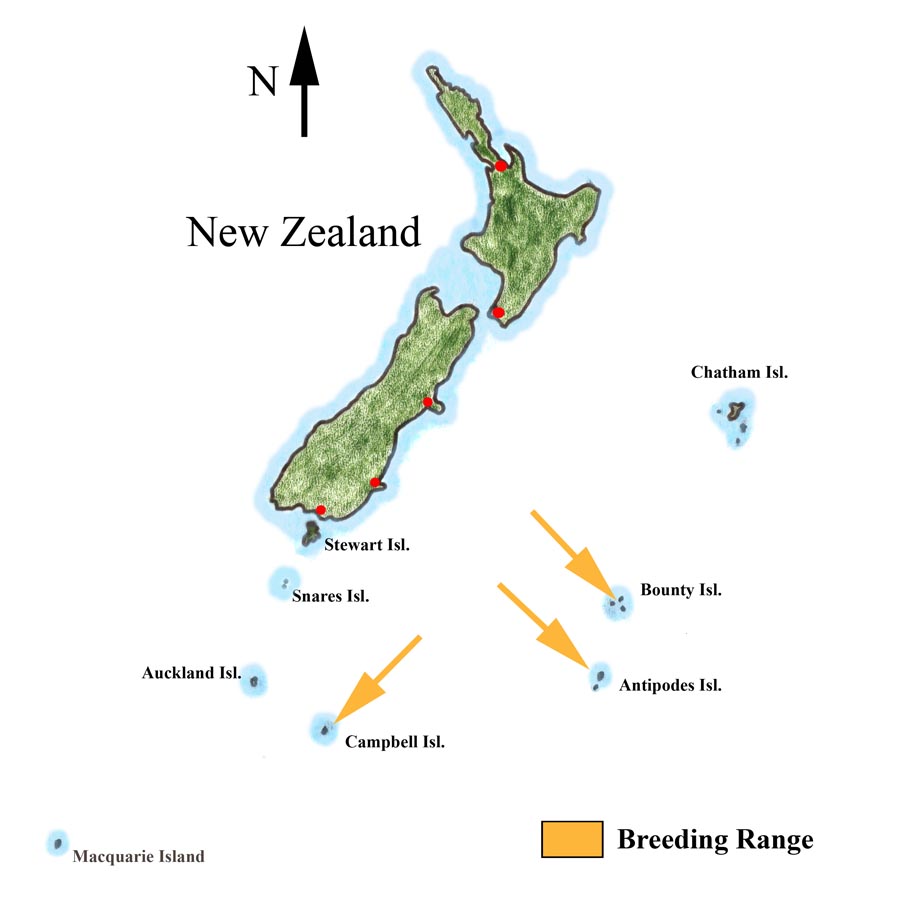
First eggs are laid at the beginning of October on the Antipodes, with peak laying just over a week later. Breeding is thought to commence 2-3 weeks later at the slightly more northerly Bounty Islands. This seems questionable, given that in Rockhopper Penguins more northerly populations tend to breed earlier.
Laying / Brood Reduction Mechanism
First eggs are usually laid about 2 weeks after the arrival of female birds at the colony. Two eggs are laid over a period of about 4 days, a smaller greenish (A) egg, followed by the larger whitish (B) egg.
All crested penguin species display egg dimorphism and associated brood reduction mechanisms, favouring the second and larger (B) egg. There are however significant differences in the extent of dimorphism and the kind of brood reduction behaviour displayed. The first (A) and second (B) eggs of the Erect-Crested Penguin averaged 83.7 and 150.7 g (80% mean difference), making them the most dimorphic of any penguin species (Miskelly and Carey 1990. Univ. Canterbury Antipod. Isl. Exped. Rep. p.2-11). Macaroni Penguins eggs are also highly dimorphic with the egg having respective mean masses of 94 and 145 g, and a mean difference of about 55% (Barlow 2001. Antarctic Sci. 13(3), p.286-287).
Macaroni, Royal and Erect-Crested Penguins show the most extreme form of brood reduction and appear to actively remove the first laid (A) egg from the nest, whilst the Rockhopper, Fiordland Crested and Snares Penguins do not actively remove the (A) egg and may in rare cases even raise 2 chicks. To what extent eggs are intentionally ejected from the nest is a matter of debate. In one study, about half of all egg losses were considered deliberate whilst the rest occurred as an accidental result of egg rearrangements in the nest (Miskelly and Carey 1990). 97% of pairs lost one egg in the four days following clutch completion, and in 98% of cases this was the (A) egg. However, studies on Antipodes in 1998 reached the conclusion that egg loss was accidental (Spencer-Davis 2001. Natural History Magazine). This was based on the observation that it was mechanically difficult to incubate both eggs and that the birds frequently moved around trying to accommodate both, in the process often dislodging the smaller (A) egg. Further, displaced eggs were recovered if placed near the incubating adult, which was interpreted as meaning that they had not intended to lose the egg (although this may be a simple reflex-like behaviour).
The reader is referred to the detailed section on brood reduction mechanisms on the Macaroni Penguin page, since this species has been subjected to much more study and has the apparently most similar mechanism.
Incubation Duties / Nest Relief
The incubation period of the Erect-Crested Penguin is thought to last for about 35 days. The distribution of incubation duties is not known in detail. It has however been noted that males often remain at the nest for days after completion of the clutch. This seems wasteful since only the female parent is initially needed for incubation and the other could theoretically forage. It is possible that this serves to protect the female from aggression by unmated birds or neighbouring males, which has been observed to result in egg loss (Spencer-Davis 2001. Natural History Magazine).
Brood / Guard Phase
Only a single chick is generally raised. Chicks hatch with a thin coat of down (protoptile plumage) which allows efficient heat transfer from the brooding parent. A thicker down (mesoptyl plumage) is developed within 2-3 weeks. Young chicks are brooded under the parent, but rapidly become too large to fit entirely under it. Large chicks lie partially covered with their heads under the parent or lean closely against it. The mesoptyl down is crucial for thermoemancipation of the chicks, and is a prerequisite for the transition from the guard to the creche phase which usually occurs after about 3 weeks. The male parent is responsible for the chick for the first 2-3 weeks of the brood / guard phase, whilst the female forages and returns regularly to provision the chick.
Creche Phase
Once the parents stop guarding them and are absent foraging at the same time, Erect-Crested Penguin chicks tend to congregate in groups known as creches. Chicks generally join creches located within a few meters of their nests. Upon return to the nest, parental birds may call their chicks (see below) in response to which the chicks approach the parent in order to be fed. Food chases have been observed in Erect-Crested Penguins. The exact function of these chases, where the adult runs away from the chick causing the latter to chase it, are not known.
Acoustic Parent-Chick Recognition
Detailed studies have not been performed on acoustic parent-chick recognition in Erect-Crested Penguins. It is however likely that it bears resemblance to that observed between parents and chicks in other crested penguin species. Contact calls are considered most similar to those of the Fiordland Penguin. Chicks call by way of short "cheeps" lasting about 0.1-0.3 sec which are usually repeated several times with about 0.5-0.7 sec intervals. The "cheeps" are characterized by a rapid rise in pitch followed by a fall from 5 to 3 kHz (Warham, 1975. "The Biology of Penguins" (ed. Stonehouse), p.189-269).
Fledging
Erect-Crested Penguin chicks must develop their water-proof juvenile down so that they can depart to sea to forage. Before fledging, males may reach masses of over 3.5 kg with females about 500 g less. Fledging generally occurs after about 70 days. Fledglings and yearlings are both distinguishable from adult birds by having paler chins and short, paler, and non-erect crests. Breeding age is generally reached after about 5 years.
Post-Breeding Moult
On the Antipodes Islands, once their chicks have fledged, adult birds spend about 1 month at sea foraging in order to gain weight in preparation for the annual moult. The moult occurs at the colony starting near the end of February and lasts 26-30 days. Non-breeding birds tend to moult about 2 weeks earlier.
|
 Pinguino de Sclater
 Gorfou de Sclater
 Kronenpinguin